

ORIGINAL MOTION PICTURE SOUNDTRACK
A story can also be heard.
Discover how the soundtrack of Amy was created.
ABOUT AMY
Alan has a very special relationship with his car: a 1990 Nissan 300ZX named Amy. What begins as an almost perfect connection between a man and his machine changes when Amy discovers that Alan has a date with another girl.
Amid jealousy, lies, and a relationship that soon reveals its darker side, an apparently ordinary journey turns into a true nightmare. Directed by Ismael Luna, Amy blends suspense, horror, and a touch of fantasy to turn a car with a will of its own into the unexpected protagonist of a story about obsession, control, and toxic relationships.


How the Soundtrack of Amy Was Created
A soundtrack that refused to stay in the background
From the very beginning, the music for Amy was conceived as something more than just an accompaniment to the images.
When Ismael Luna contacted Rubén Gallardo to compose the soundtrack, the project presented a particularly interesting challenge: to tell the story of Alan and Amy’s relationship through music—a relationship that begins with fascination and connection, but gradually transforms into obsession, jealousy, rage, and fear.
The film called for a very specific sonic identity. The goal was to draw on the aesthetic associated with suspense and horror films of the 1980s and early 1990s, without turning the music into a mere nostalgic recreation. Instead, the intention was to use that language as a starting point for creating something original.
The result was a hybrid score combining symphonic orchestra, electric bass, guitars, piano, and vintage-style synthesizers, blending acoustic and electronic elements to create a dark, physical, and increasingly unsettling sonic universe
Rubén worked on the score for approximately six months, from the first sketches to the final version of the soundtrack. From the very beginning, one fundamental idea was at the heart of his approach: the music had to become another character in the story, capable of elevating the scenes and actively contributing to the narrative tension.
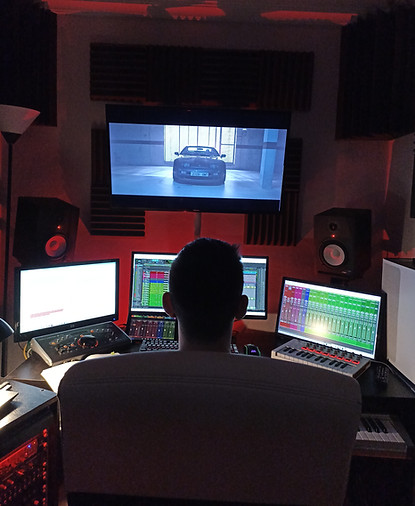
Rubén Gallardo composing Amy (2024)
Back to the Sounds of an Era
One of the fundamental elements of Amy’s sonic identity is its connection to the musical aesthetic of the 1980s. Rubén drew inspiration from composers such as John Carpenter, looking for that distinctive combination of synthesizers, darkness, repetition, tension, and electronic atmospheres.
But recreating an era doesn’t simply mean using an old synthesizer.
The synthesizers that defined that decade each had very different personalities. The Roland Juno-106, introduced in 1984, is a good example: its sound could produce powerful basses, wide pads, and tones that work particularly well in a cinematic mix, as well as featuring a chorus effect that became one of its most recognizable characteristics.
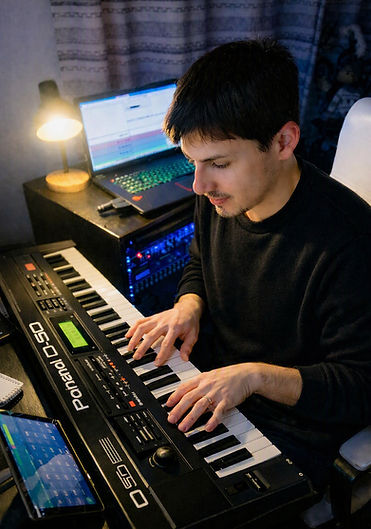
Another defining sound of the second half of the decade was the Roland D-50, released in 1987. Its LA synthesis system combined samples and synthesis to create sounds that could feel warm, bright, strange, or downright futuristic for its time. And then there was the Yamaha DX7, released in 1983—one of the most important digital synthesizers of the decade, particularly known for its FM synthesis.
These instruments help us understand the aesthetic universe from which Amy draws: electronic sounds that we now immediately recognize as belonging to a particular era, but which at the time represented a completely new way of imagining music. In Amy, that vintage sound isn’t there simply to tell us, “this takes place in the ’80s/’90s.” It is used as a narrative tool.
The electronics provide Amy with her artificial character. The orchestra gives her emotional depth. The piano brings intimacy. The guitars and bass add a physical dimension. And together, they ultimately become a single sonic organism.

The Original Soundtrack of Amy took six months of work, from the first sketch to its completion. It was a meticulous process, built up gradually, in which every sound, every instrument, every texture, and every detail found its place, ultimately shaping Amy’s sonic universe.
Six months of composition, production, experimentation, and listening to ensure that the music not only accompanied the story, but became part of it. Six months to bring Amy to life.

When the Low Frequencies Start to Speak
There is one particularly important characteristic in the conception of this soundtrack: the sub-bass. It’s not simply about making the music sound bassier. Sub-bass operates in a frequency range that we often don’t consciously perceive as a musical note. On a suitable sound system, however, it can be physically felt, creating a sense of depth, threat, and pressure.
In Amy, this dimension is directly tied to the psychological evolution of the story. The tension doesn’t appear all at once. It grows. At first, there is space. Then, small signals begin to emerge. The elements start to build up. The low frequencies become more present. The different layers begin to respond to one another. The atmosphere grows increasingly dense.
And when we reach the end, everything that has been building throughout the soundtrack finally comes together. In a way, it is the musical equivalent of Amy’s jealousy—an emotion that starts small and gradually takes up more and more space, until it becomes impossible to ignore.
Music That Moves
Spatiality is also part of the composition.
The soundtrack was crafted to create an immersive sensation in which elements can move from left to right, from near to far, and from front to back, creating different layers of depth. This allows the instruments to do more than simply sit within a stereo mix—they seem to occupy a space. And this is where another of the score’s most interesting ideas comes into play: the instruments talk to one another.
Not everything follows a traditional melody-and-accompaniment structure. A musical figure may appear in one instrument and find a response in another. A synthesizer asks a question. A string answers. A bass carries the tension forward. A texture emerges in the background.
The piano can occupy a more intimate space while the orchestra grows around it. These small musical conversations give the soundtrack a sense of movement, even when apparently nothing is happening. That is why the concept goes beyond the leitmotif.
A leitmotif can identify a character, an idea, or an emotion. In Amy, there is also a progressive construction of an entire sonic ecosystem that evolves alongside the story.

The Album: Hearing What the Film Can’t Always Show

There is an important difference between hearing the music within the film and discovering the soundtrack on its own. In the cinema, the music coexists with the image, dialogue, sound effects, engines, and all the other elements that make up the cinematic experience. Within that combination, some musical details can easily go unnoticed.
The album allows you to stop and listen to them.
It allows you to discover the different layers, perceive how the space moves, recognize how certain instruments appear and disappear, and, above all, experience the evolution of the tension without the image telling us what we are supposed to feel.
That is why Amy’s CD was conceived as more than simply a collection of the tracks used in the film. The intention was to take the experience one step further and create an independent listening experience in which the music could fully develop its spatial and emotional potential.
To achieve this, the soundtrack was specially crafted for surround sound systems equipped with a subwoofer, with meticulous attention paid to the depth, movement, and physical dimension of the low frequencies. Rubén’s team worked for months on this process across two different studios, ensuring that every element found its place within a sonic space capable of surrounding the listener.
Spatiality is not conceived simply as a spectacular effect, but as part of the musical narrative itself. One sound can move closer, another can fade into the background, a texture can shift from one side to the other, and the sub-bass can begin almost imperceptibly before eventually filling the entire space.
The different layers seem to speak to one another, creating a sense of depth and movement that allows new details to emerge with every listen. And that is precisely where the experience becomes more than just auditory.
It becomes physical. The film tells the story. The album lets you feel it from within.

Now, I want you to listen to it
When I composed the soundtrack for Amy, there was one thing I knew for certain: I didn’t want the music to simply accompany the film. I wanted it to have a life of its own.
For months, I built every sound, every texture, every low frequency, every movement. Little by little, the music grew alongside me and alongside Amy’s story. And although many of these elements work within the film, I knew that part of them could only truly be discovered once the music stood on its own. That’s why this album is so special to me. Here, there are no images telling you what to look at. No dialogue explaining what is happening. There is only the music. And now, I want you to listen to it.
I invite you to put on a pair of headphones, or listen on a surround sound system with a subwoofer, and close your eyes. Let it in. Listen to how it begins. How the first layers slowly emerge. How the instruments begin to speak to one another. How the low frequencies gradually build without you even realizing it. How the space becomes larger and larger. And how that tension, barely perceptible at first, eventually takes over everything. Because that is also what happens to Amy. Her jealousy grows. Her anger grows. Her obsession grows. And the music grows with her. I wanted that journey to be something you could feel. Not simply something you listen to, but something that gradually surrounds you until there comes a moment when you can no longer escape it. And then the ending will arrive.
Everything you have heard before will be there. That climax can be found in the final track, “We Will Always Be Together,” where the orchestra, the synthesizers, the piano, the guitars, the bass, the low frequencies, and Amy’s engine all come together. Everything at once. Everything pushed to the limit.
That moment is, for me, the heart of the soundtrack. Because at that point, I don’t know whether you’re listening to music, a machine, or Amy coming to life. Perhaps it’s all three. So now, I don’t want to explain anything else. I want you to discover it for yourself.
Put on your headphones. Turn up the volume. Close your eyes. And let Amy… take you all the way to the end.

¡OUT NOW!
Available on all digital platforms


Credits
Music composed by Rubén Gallardo
Ambient sound design: Aitor Ribas
Musical arrangements: Rubén Gallardo & Marco del Valle
Synthesizer programming: Rubén Gallardo & Marco del Valle
Original Motion Picture Soundtrack published by Soundframe Records (ASCAP & SGAE)
Original Soundtrack Production: Rubén Gallardo & Soundframe Records
Album Production: La Naranja Biónica
Album Co-Production: Rubén Gallardo
Production Manager: Raquel Acedo
Graphic design: Alejandro Illán (Kip Studio)
Score Coordination: Marco del Valle
Music Supervision: Raúl Segovia
Score Editing: Raúl Segovia
Soloists: Marco del Valle, Aitor Ribas, Suri Marian, Adrián Sáez, Lorena Garrido
Recording Production: Rubén Gallardo
Soundtrack Recording: Soundframe Studios
Soundtrack Mixing: Soundframe Studios
Mastering: Soundframe Studios
Music Administration: Soundframe Records Administration Department
Music Distribution: CD Baby
Digital Release Management: Soundframe Division TM
Music published by Soundframe Records (ASCAP & SGAE)
Original Motion Picture Soundtrack registered with SGAE (Sociedad General de Autores y Editores) and ASCAP (American Society of Composers, Authors and Publishers)
Registration Code: SF-R2026-G001
© 2026 Rubén Gallardo Acedo
℗ 2026 Soundframe Records / Rubén Gallardo
All rights reserved worldwide.



Rubén gallardo
·
·


© 2026 Rubén Gallardo. All rights reserved..